
|
|
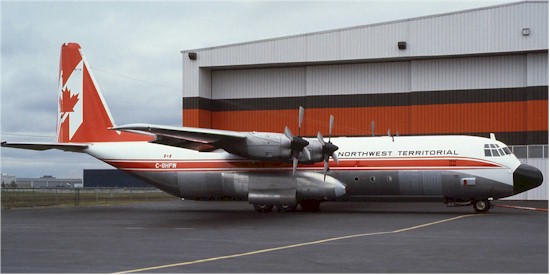
 Click the icon for more of info on the extensive usage of the Hercules. Terry Baker dug through our library of airline magazines and found a list of destinations published in PWA's 'Keeping Posted' from August 1969. Editor's Note: Photos in AC Connector livery are identified at the original sources as having been taken in 1999, after the sale from AC to First Air. Possibly the aircraft had not yet been re-painted. See also NetLetter #1436. |
 |
|
Photo courtesy of Danny Grew
at Toronto, November 3, 1983
|
 |
|
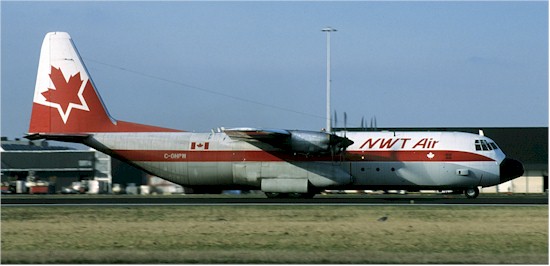
Photo courtesy of Joop de Groot
from the René Buschmann Collection
at Amsterdam, January 1999
|

|
Submitted by Michael Dyrenfurth,
Professor Emeritus, Purdue University -
Hello and many thanks for the interesting array of facts and history you share via your NetLetter.
Please help, in order to complete a family history narrative I need to know and hopefully one of you many readers can illuminate.
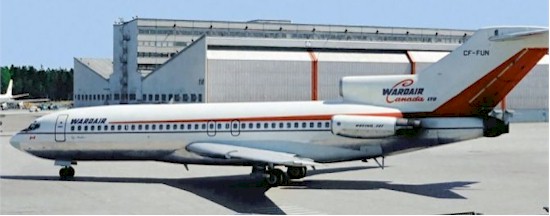
Did Wardair’s B-727 ever fly to Europe using Reykjavik or Sondrestrom (now Kangerlussuaq), Greenland (SFJ) as its stopover? My question pertains to a summer of 1967 flight to England. My wife and I flew on this aircraft on our honeymoon.
I was sure that we landed in Reykjavik, however, the time passage since 1967 has obscured some of the details.
My difficulty is identifying details about the Sondrestrom Fjord refueling stop. Was it at the US Airforce base near there? I was not aware that civilian flights were permitted use of such facilities or, if not there, was it at Sondrestrom, Greenland?
Thanks in advance to anyone who can help answer this question
Collegially,
Michael Dyrenfurth
|
|
Our Terry Baker responded:
Hello Michael,
The following info can be found at:
www.canadianaviationmuseum.ca The B-727, registration CF-FUN, owned by Wardair flew to Europe, was spotted at Copenhagen on July 1, 1967, Gatwick October 13, 1967 and April 18, 1968 and Dusseldorf 1972.
Refueling stops were made at either Gander, Newfoundland, or Sondrestrom Fjord, Greenland.
Yes, Sondrestrom was a US forces base originally named Bluie West-8. TCA/Air Canada used that refuelling stop when ferrying their Vickers Viscounts to Canada.
Scandinavian Airlines (SAS) used the stop on their Copenhagen/Winnipeg/Los Angeles route.
At London Gatwick, CF-FUN arrived at 11:00 am local and departed again for Western Canada at 10:00 pm local. It was known as the “Clockwork Mouse”- never delayed due to mechanical issues. |
 |
|
Submitted by Jack Miles Jr.
I would like to add some comments to Tony Connolly’s reference, in NetLetter #1547, to the Lockheed Hercules L100-30 C-GHPW.
There are some steps missing in the history of this aircraft. It was indeed sold to NWT Air in 1984/85 (I was involved at PWA at the time) and they commenced operating the aircraft in the North and at times overseas. However Air Canada purchased NWT Air in late 1980s and NWT Air changed their logo with a subtle influence of Air Canada’s ownership. I did some brief contract work for NWT Air in 1992 going overseas to seek work from the Red Cross in Geneva, without success.
The President of the NWT Air at the time was from Air Canada. The point that I make is that Air Canada was actually an owner and operator of this Lockheed L-100-30, through NWT Air.
No such record of having owned this aircraft type seems to exist in Air Canada history. It was Air Canada that sold NWT Air to First Air in June of 1997 and, in that sale, C-GHPW was included. I thought that this might be of interest to your readers.
Editors' Note: Mr. Miles comments certainly tweaked our curiosity. See Wayne's Wings section for our research of the period when NWT Air was one of Air Canada's connectors.
|
 |
|
Photo courtesy of Freek Blokzijl
at Amsterdam Schiphol Airport, January 23, 1989
|
 Terry Baker, co-founder of the NetLetter scours the internet for aviation related Trivia and Travel Tips for you, our readers, to peruse.
At Toronto Pearson, we’re implementing innovative digital solutions to streamline passenger experience.
The Advance CBSA Declaration technology helps returning travellers to expedite customs and immigration; the U.S. Mobile Passport Control App:
www.cbp.gov/travel/us-citizens/mobile-passport-control allows travellers to expedite U.S. customs by submitting personal information in advance of travel.
|
|
Visiting Cancun (CUN).
The VISITAX amount is USD$17 per person, or CAD$22.50 or GBP13.50. Earlier reports suggested scammers were asking tourists to pay up to USD$68 upon arrival. VISITAX agents are now stationed at all terminals at Cancun airport arrivals and departures, located in all airside and landside areas in the airport. They are easily identifiable, and if they approach you, it is MANDATORY TO STOP. Source: travelkore.com |
|
Edmonton, Cooking Lake Airport.
Flashback to 1937 - Inaugural airmail flight to the Yukon The summer of 2024 marked the 87th anniversary of the inaugural airmail flight from Cooking Lake Airport to the Yukon. The flight left Cooking Lake at 0815 on July 5, 1937 and arrived at Dawson City at 1230 on July 7, 1937 to deliver its' cargo of mail and good wishes. The flight made stops at Bear Lake (Grande Prairie), Fort Nelson, Nelson Forks, Lower Post (Hudson Bay Outpost on Liard River), and Whitehorse on its way to Dawson City. For the return trip the flight departed Dawson City at 02:30 on July 8, 1937 with stops in Whitehorse, Lower Post, Fort Nelson, Charlie Lake (near Fort St. John) and arrived back at Cooking Lake at 21:15 after a long day of flying. The aircraft used for the flight was a Ford Trimotor on floats CF-BEP (one of only 3 ever built in a seaplane configuration) and operated by United Air Transport, owned by Grant McConachie. In 1939, CF-BEP was badly damaged in a runway mishap with a Hawker Hurricane at Vancouver. The only part of the aircraft that remains today is a "blow pot" which was used to warm the engine in the winter, and is on display in the Yukon Transportation Museum. In 1995 the Alberta Government transferred ownership of the airport to the Edmonton Airport Authority with the condition that they operate it for at least 10 years.
In 2008, the Edmonton Airport Authority decided Cooking Lake Airport was no longer core to its strategy and began the devolution of the airport. Strathcona County unexpectedly decided not to exercise its right to take over the airport.
To save the airport from closure, a group of volunteers arranged to take over the airport and keep it open to the public. Today, Cooking Lake Airport is the oldest operating public airport in all of Canada, the fifth busiest community airport in Alberta, and one of only 5 CBSA approved international (CANPASS) airports in the province. Source: cookinglakeairport.weebly.com
|
 |
 |
|
Excerpt from AerialViews Volume 18 No.04
|
|
The Ultimate Wind Vane
By Layne Larsen
Most organizations acquire a surplus aircraft for various purposes are usually content to mount it on a pedestal near the entrance road i.e. a 'gate guard'. However, when Roy Harker of Princeton, British Columbia was offered a T-33 Silver Star, he wanted to go a step further and turn it into a wind vane at the Princeton Regional Airport (YDC). Until the CL-41 Tutor was introduced in 1963, The 'T-bird' was used as the advanced trainer for the RCAF pilots. Developed by Lockheed from its P-80 Shooting Star fighter in the late 1940s, Canadair built 656 CL-30 Rolls-Royce powered versions of the T-33, designated CT-133 Silver Star in RCAF service. When the RCAF disposed of much of its fleet in the 1960s, 20 aircraft were sold to the Bolivian Air Force which used them for more than three decades. Rather than retire them, Bolivia contracted Kelowna Flightcraft to rebuild and modernize the airframes, but they only had enough money to cover 18 of the aircraft, leaving the parts for the other two to Flightcraft. Dave Focott of Flightcraft saved these derelicts from the scrap yard and offered one to Mr. Harker. With the help of volunteers and $7,000 in goods and services from the community, the wind vane project was dedicated on May 4, 2013.
Source: aviationairtists.ca (Scroll down to page 14)
|
 |
 |
|
Issue dated October 1997
|
|
Revealing secret hand signs at their YUL ramp lunch room are, left to right: Station Attendants John Cameron, John Bryant, Gordie Stephenson, Yves Cuillerier and John Blair.
|
 |
 |
|
Issue dated January 1964
|
|
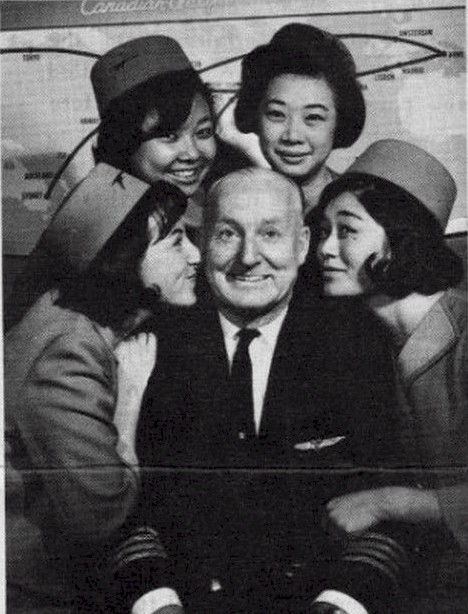
Two New Year's Eves brought double kisses for DC-8 Captain Cec McNeal from stewardesses Ina Laesecke, left, and Kumi Miyama, as Althea Young, left, and Eileen Suen kibitz behind. Situation resulted from crew crossing the International Date Line on December 31, 1963, during the Tokyo-Vancouver flight.
Photo was used to publicize Asian routes, received wide coverage across Canada and overseas.
|
 |
|
Issue dated March 1964
|
|
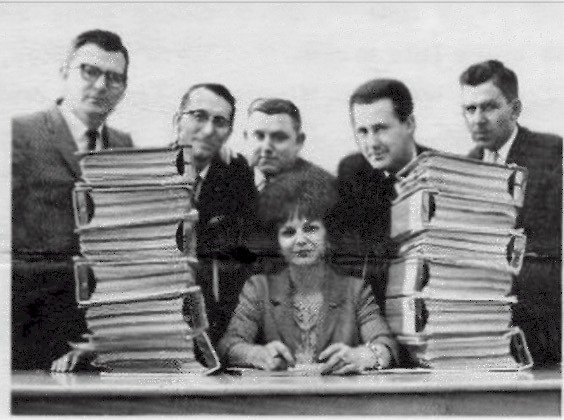
Head-high in manuals during a traffic training course in Vancouver was Prince George passenger agent Rita Thornthwaite.
Kibitzing, from left, were: Mickey Webster, Winnipeg Reservations; Peter Kimpton, Traffic Instructor, Headquarters; Dana Fraser, Instructor at Vancouver Reservations; Rod Allen, Traffic Instructor, headquarters and Pierre Cos, Training Department, Montreal.
|
 |
 Found on Facebook |
|
Posted by Janet Harrison-Draper on the Nordair page December 2, 2024. Let the holiday celebrations begin!
Sue Scola, Kim Boyd, Gail Carson, Linda Jackson, Nancy Leger, Janet Harrison-Draper and Debbie Beaupre.
|
 |